Why Old Market Halls Make Such Distinctive Indoor Streets
Learn how old market halls use entrances, roof spans and stall layouts to shape a visit, so you can choose a route and notice how the building works.
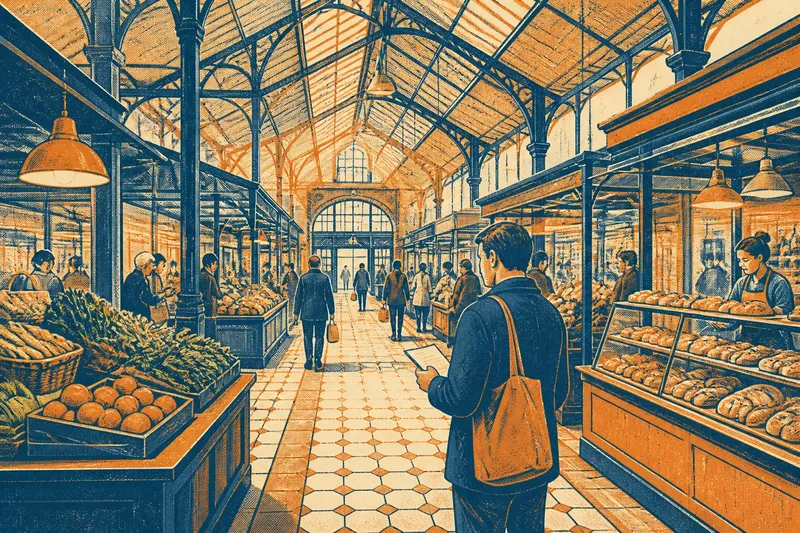
You step from a busy square into a market hall and the sound shifts: voices gather under the roof, light catches on a stall counter, and someone pauses in the aisle to check a shopping list. Old market halls can feel like indoor streets because many different activities share one covered space. Their entrances, roof and stall layout offer clues about how this particular building invites people to move and linger.
Why do old market halls feel like indoor streets?
A hall brings sellers and customers together beneath a common roof. Some have a clear central aisle, while others use intersecting passages, open floor space or more tightly arranged stalls; the layout varies with the building and its later changes.
That shared space can accommodate different kinds of visit. One person may head directly to a familiar counter while another browses or stops to talk. Rather than assuming every hall was planned as a shortcut, look at what its actual routes connect and how people use them.
What can the entrances tell you?
Notice which doors face a square, lane or shopping street, and whether the hall has openings on more than one side. Several entrances may link different approaches, but they do not by themselves prove that the building was intended as a public passage. Check where each doorway leads and whether it is open to visitors.
Look at what you meet just inside. A door opening onto a clear aisle gives an immediate view; a screen, display or turn can make the interior unfold more gradually. Neither arrangement is inherently better: one may make orientation easier, while the other can soften the transition from street to stalls.
How do the roof and daylight shape the room?
Look up from a place where you will not obstruct anyone. You may see exposed trusses, skylights, high windows or a finished ceiling that conceals the structure. These features vary from hall to hall, but they help show how the building covers a shared space.
Then notice where daylight falls. A bright area may make an aisle or entrance easier to see, while shaded edges can feel quieter. The effect depends on the hall’s openings, weather and interior fittings, so treat light as a clue to your experience rather than proof of the original design.
How can you choose a route through the stalls?
Start by identifying a visible aisle or crossing, then check whether it is clear and open to visitors. Smaller passages may bring you closer to displays, but their width and direction differ; follow signs and give sellers room to work. Some halls also have delivery access, yet service routes may be restricted or used at particular times, so do not assume a customer aisle serves that purpose.
Imagine you enter an invented hall through a side door and see a straight aisle leading to another entrance, with stall rows branching off it. You walk to the far end, notice a bakery counter on a side lane, and return by that lane after checking it is open to visitors. The result is a simple route that lets you orient yourself first, then browse without treating every passage as a shortcut.
What should you check before choosing how to explore?
- Entrances: If a door is open and its sign permits public entry, use it to orient yourself; if it is marked for staff or deliveries, choose a visitor entrance instead.
- Long views: If you can see a clear aisle ahead, use it as a first route; if stalls block the view, pause at the edge and follow signs or visible public passages.
- Crossings: If a crossing is open and unobstructed, use it to reach another aisle; if it is blocked or marked as restricted, stay on the public route.
- Roof light: If high windows or skylights make a route easy to see, use them as orientation cues; if the space is dim, rely on signs and avoid assuming a darker corner is open.
- Stall edges: If a counter faces the aisle and appears open, approach without blocking others; if it is closed or being restocked, continue to another stall.
- Thresholds: If a change in flooring or a screen marks an entrance, check for signs or a step before proceeding; if access is unclear, use a clearly marked doorway.
It is not worth counting every stall or trying to identify every beam. A few observations about entrances, visible routes and open counters are usually enough to make your visit easier to read.
What questions help you read an old market hall?
Why does this hall have several doors?
Multiple doors can give visitors different ways to enter, but their purpose depends on the building and current access rules. Check the signs and the streets each entrance faces before treating them as a route through.
Why does the centre feel more open than the edges?
The main aisle may leave more space for movement, while stalls along the perimeter create places to browse. Roof supports, displays and daylight can also affect how open each area feels.
Can I walk through a market hall without shopping?
Access rules differ, so check signs at the entrances and follow any local guidance. If the hall is open to visitors, be considerate of customers and sellers rather than blocking a counter or narrow aisle.
Are the stalls part of the original plan?
Some halls have fixed stall arrangements, while others have been altered as their uses changed. Compare the stalls with the building’s columns and walls, but avoid assuming that the present layout is unchanged from the original design.
How does the architecture shape your visit?
An old market hall can offer a sheltered place to shop, eat or pause, but each building handles access and movement differently. The most useful way to read one is to match what you see—open doors, marked routes, light and stall positions—with the choices available to you as a visitor.
For a closer look, begin at a public entrance, find a route that is clearly open, and let the stalls draw your attention only where there is room to stop. That approach makes the building easier to understand while leaving space for the ordinary business of the market.