The Souvenir That Claims to Tell the Whole Story
Choose a souvenir that recalls one real encounter, not an entire culture, and learn how to check its origin, make a thoughtful choice and keep its story.
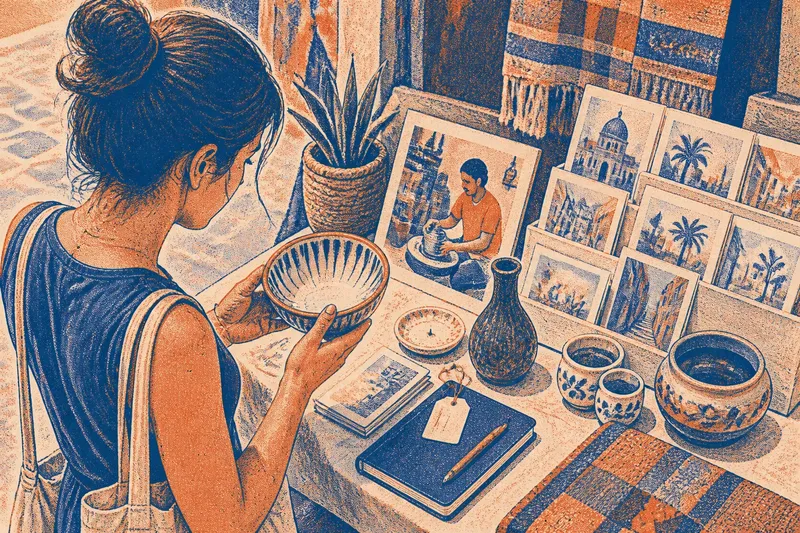
At a market stall, you spot a hand-painted bowl beside a rack of postcards and wonder which one captures the place. A thoughtful souvenir does not have to sum up a town or culture; it can simply bring back a detail you enjoyed.
That distinction keeps a purchase in proportion. An object can remind you of a maker, a meal or a particular street without being treated as a symbol for everyone who lives there.
What should a souvenir remind you of?
Before you browse, decide what you might actually use or display. Perhaps you want a small print for your desk, a recipe card for the kitchen or a cup for everyday tea. This gives your search a practical boundary without asking one object to explain a destination.
You do not need to buy something at every stop. If nothing suits your home or your budget, a postcard, ticket or phone note can do the job without becoming another item to store.
How can you find out who made it?
Look for a maker’s name, workshop details or a clear description of where the object came from. If a seller is available, ask a simple question such as, “Who made this?” or “What is it made from?” A brief answer may be enough; you need not turn a purchase into an interview.
Words such as “traditional” or “authentic” do not tell you by themselves who made an item or how it was produced. If the origin is unclear, you can still choose it for its design or usefulness, but avoid filling in the missing details with a story you cannot verify.
Say you are choosing between a locally labelled print and a similar one with no maker information. You want a print connected to a particular workshop visit. You ask the seller about the labelled print, and they name the workshop; the other one has no origin details. The first better fits your stated purpose, while the second may still suit you if you simply prefer its colours.
What should you check before buying?
- Maker or origin: If a name or workshop is given and that connection matters to you, keep the details; if the source is unclear, treat it as an object you like rather than a maker’s work.
- Material: If the label identifies a material you can safely use or display, continue considering it; if it is unclear or unsuitable for your intended use, ask the seller or choose another item.
- Description: If the account describes this object specifically, use that information; if it makes broad claims about a whole community, do not take those claims as established fact.
- Care: If the seller’s care instructions fit your routine, the item may be practical; if they do not, choose something easier to maintain.
- Journey home: If the item can be packed securely and carried within your travel arrangements, proceed if you still want it; if not, ask about suitable packaging or leave it behind.
- Travel rules: If food, plant material, antiques or another restricted category is involved, check the relevant official rules before buying; if the rules are unclear, do not take the item across a border until you have confirmed what is allowed.
What is not worth the effort? Trying to make a single purchase prove that you understand a culture. Nor do you need to demand a full account of a seller’s supply chain when a simple question can clarify what you are buying.
How do you keep a souvenir’s context?
Write down the shop or maker’s name and the detail you want to remember on a receipt, tag or phone note. If you do not know a name, leave it blank rather than guessing.
For a photograph, add a sentence that explains what you noticed. “The potter showed me the glaze on the rim” will be more useful later than a caption that only names the town.
What questions do travellers ask about souvenirs?
Can a mass-produced item still be a meaningful souvenir?
Yes. A postcard or printed tote can remind you of a trip without being locally made. Keep its origin separate from the memory it brings back.
Is buying directly from a maker essential?
No. Buying directly can make it easier to learn who made an object, but it is not the only thoughtful option. A shop purchase can suit you if its description is clear enough for your purpose.
What if I cannot verify an item’s origin?
Decide whether you still want it for its appearance or use, without treating it as a verified local craft. If knowing its origin is central to your choice, look for another item or leave without buying.
Can I choose a souvenir simply because I like it?
Of course. You can enjoy an object’s colour, shape or usefulness without presenting it as representative of a place. Keeping that distinction in mind makes for a more honest choice.
For a souvenir that recalls an encounter, keep a brief note with the object and describe only what you know: who made it, where you found it or what drew your attention. That small record helps the item remain personal, rather than turning it into a claim about the whole destination.